
Why Shock-Sensitive Material Delivery Needs a Vibration Budget
Why Shock-Sensitive Material Delivery Needs a Vibration Budget
Precision components, gauges, and protected assemblies are often reduced to a simple internal logistics task: move them from point A to point B. For cargo that is sensitive to shock, sway, or orientation, however, delivery quality is not defined by arrival time alone. Packaging stability, route smoothness, motion consistency, and the receiving condition at the destination all contribute to whether the item is truly delivered in a usable state. This is where a practical vibration budget becomes useful. It turns a general instruction to handle a load carefully into operating conditions that a mobile robot system can repeat and verify.
Payload Capacity Does Not Define Transport Conditions
An AMR payload rating answers an important question: how much mass can the chassis carry. It does not describe the disturbance a load will experience on its way through a facility. Floor transitions, expansion joints, lateral movement in turns, obstacle avoidance, and restart behavior can each introduce a different change in acceleration. When those factors are left to individual driving habits or informal caution, delivery quality becomes difficult to reproduce as the fleet grows. A better approach is to put the load center of gravity, cushioning method, permitted orientation, and route characteristics into the same task definition.
Break the Vibration Budget into Four Operating Layers
A vibration budget does not require an abstract universal limit. It means deciding which disturbances can be absorbed by the carrier and which must be avoided through route and motion design. The first layer is the carrier: a load should sit on a stable base, with locating features and cushioning that match the workpiece. The second is the route: a standard path and a fine-handling path may begin in the same area but should not be treated as identical. The third is motion: starts, stops, turns, and floor transitions need parameters appropriate to the load class. The fourth is handoff: arrival, placement, and departure deserve the same control as travel.
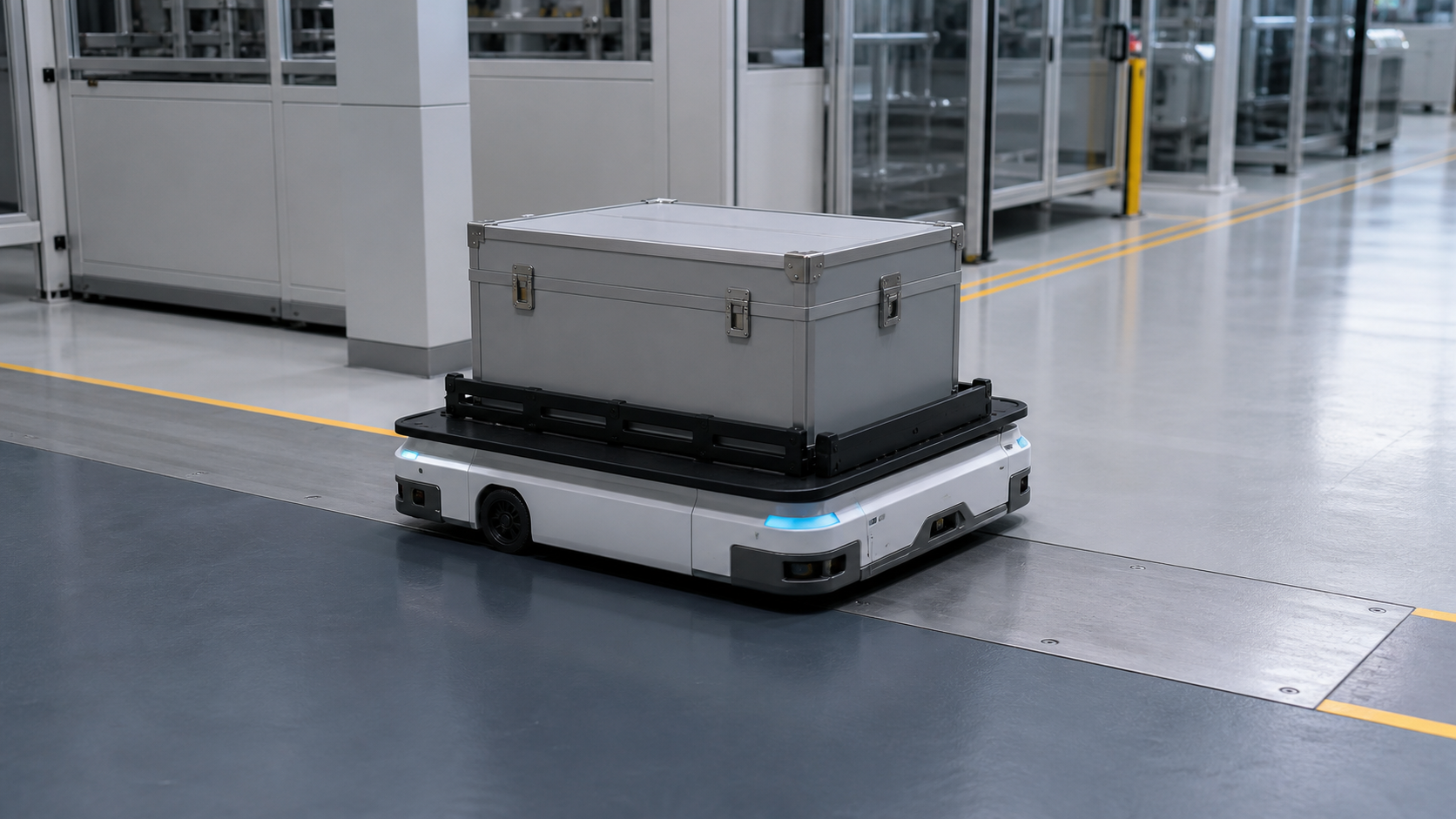
Figure 1: A flatbed AMR follows a controlled route across a smooth engineered floor transition
Use Task Classes Instead of One Speed for the Whole Facility
A default set of robot parameters may work well for general materials, but sensitive delivery should not be reduced to making every AMR slower. Different carriers call for different task classes. A fixture with a high or offset center of gravity may need a defined turning radius, a restricted route category, and a predictable recovery rule after an obstruction. A sealed crate with internal damping may be more sensitive to transition speed and stopping behavior. The value of a task template is that these distinctions do not need to be explained from scratch every time a shift changes, a new robot joins the fleet, or a similar route is introduced.
Arrival Must Confirm That the Load Can Be Set Down
The final handoff is often where a good trip loses its quality. The receiving station needs more than a marked parking point. Its support height, locating features, available status, and stability after placement all matter. A reliable arrival should therefore confirm that the receiving position is ready, that the support surface is aligned, and that the carrier can be settled without introducing a new shock event. For high-value or orientation-sensitive items, recording that confirmation is also the start of useful traceability.
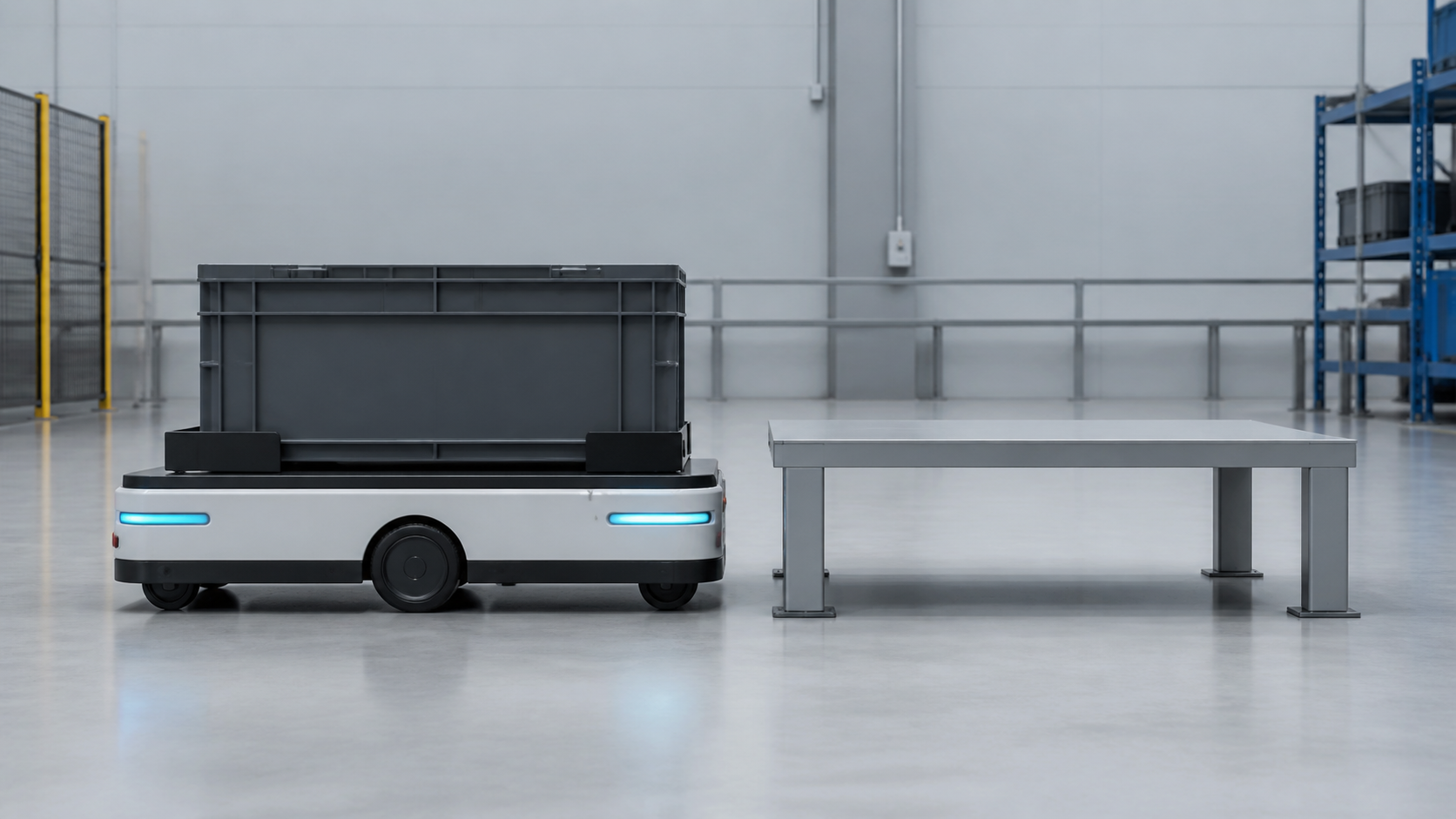
Figure 2: A flatbed AMR approaches an equal-height receiving table for a controlled handoff
Start with a Representative Route, Not a Generic Demonstration
A useful design review begins with the actual task envelope. Choose a representative workpiece or carrier, then walk the full route: loading, acceleration, turns, door thresholds, floor transitions, waiting areas, arrival alignment, and the return of the empty carrier. The objective is not to make a one-off demonstration look smooth. It is to identify where the task can accumulate uncertainty and where the process needs a controlled condition. A modest change, such as adding a flush transition plate, a short low-speed zone, or a positive location feature at the destination, can remove a recurring source of disturbance before it reaches the workpiece.
This approach also makes acceptance more meaningful. Instead of approving a robot only because it completes a route, the team can verify whether it completes the selected route with the intended carrier, task class, and handoff confirmation. That creates a shared reference for operations, manufacturing engineering, and equipment teams. When the layout changes later, the reference makes it easier to decide whether a route remains suitable or whether the vibration budget needs to be revisited.
Make Transport Quality Reviewable
Not every sensitive-delivery task needs complex instrumentation. What matters is that operations can answer a few basic questions after an exception: which task class was used, which route was selected, whether the task experienced an unplanned stop or reroute, and whether the destination completed its support and placement confirmation. Connected to normal exception records, that information helps a team distinguish a carrier-design issue from a route condition or a receiving-station problem. It is more useful than a one-time reduction in speed because the operating condition can be adjusted as the facility changes.
Extend Robot Stability to the Workpiece
A flatbed AMR contributes more than mobility when it supports precision logistics. Once carrier design, route choice, motion behavior, and receiving conditions are managed as one task, the stability of the robot can be extended to the condition of the workpiece. For manufacturers introducing mobile robotics into precision production, testing, or assembly processes, a vibration budget is a concrete engineering step from moving material successfully to delivering it in a controlled, repeatable state.


邮箱
邮箱验证*
*


