
AMR Wireless Design: From Coverage Maps to Recoverable Operations
AMR Wireless Design: From Coverage Maps to Recoverable Operations
Many AMR projects discover a deceptively small problem after maps, stations, and routes are already in place: vehicles repeatedly search for a connection near turns, equipment edges, or recently reconfigured areas. What the operation team sees is usually late task acknowledgements, stale status updates, or a robot waiting where it should not. The issue is not always a single coverage hole. More often, mobile connectivity and robot behavior were designed as separate systems.
For a mobile robot, wireless is not a static coverage map. It is a changing operating condition shaped by route geometry, speed, shielding, roaming events, and application load. The useful acceptance question is not whether a device can connect at one coordinate. It is whether the robot can keep a predictable task rhythm on critical route segments and enter a recoverable state when communications degrade.
Translate a network symptom into an operational risk
Metal racking, enclosed machinery, moving tooling, and new partitions continuously reshape RF behavior in a factory. For a fixed terminal, weaker signal at one location may only mean a slower request. For an AMR, the same condition can occur at an intersection, immediately before a handoff, or during a loaded turn. That is why a communications issue should first be expressed as an operating risk: Which segment delays task confirmation? Which segment makes state reporting late? Where could a delay move a wait event into an unsuitable location?
The first design move is to separate traffic by its purpose. Core obstacle avoidance and basic safety protection should remain within a locally executable robot control boundary. Task dispatch, station confirmations, logs, video, and diagnostics can then be assigned different timing, retry, and offline behaviors. This prevents a fluctuating connection from being treated either as a complete loss of control or as a harmless IT alert.
Validate wireless performance along the route, not only on a heat map
A practical acceptance plan starts with the path the robot actually travels. Break the path into straight runs, turns, intersections, equipment-adjacent segments, station approaches, waiting bays, and charging or handoff areas. For each segment, record vehicle speed, load-carrier envelope, neighboring access points, roaming events, retry patterns, and application response. Pass or fail does not need a universal threshold detached from the use case. It should be tied to observable operating outcomes: continuous task progress, timely confirmation, and waiting that remains inside a safe position.
The route should also be tested under production-like conditions. A loaded carrier changes shielding. Running equipment introduces reflections and noise. Production timing changes network load. Including these conditions in a repeat route test is how a team finds the difference between a network that connects while a vehicle is still and one that remains dependable while it moves.
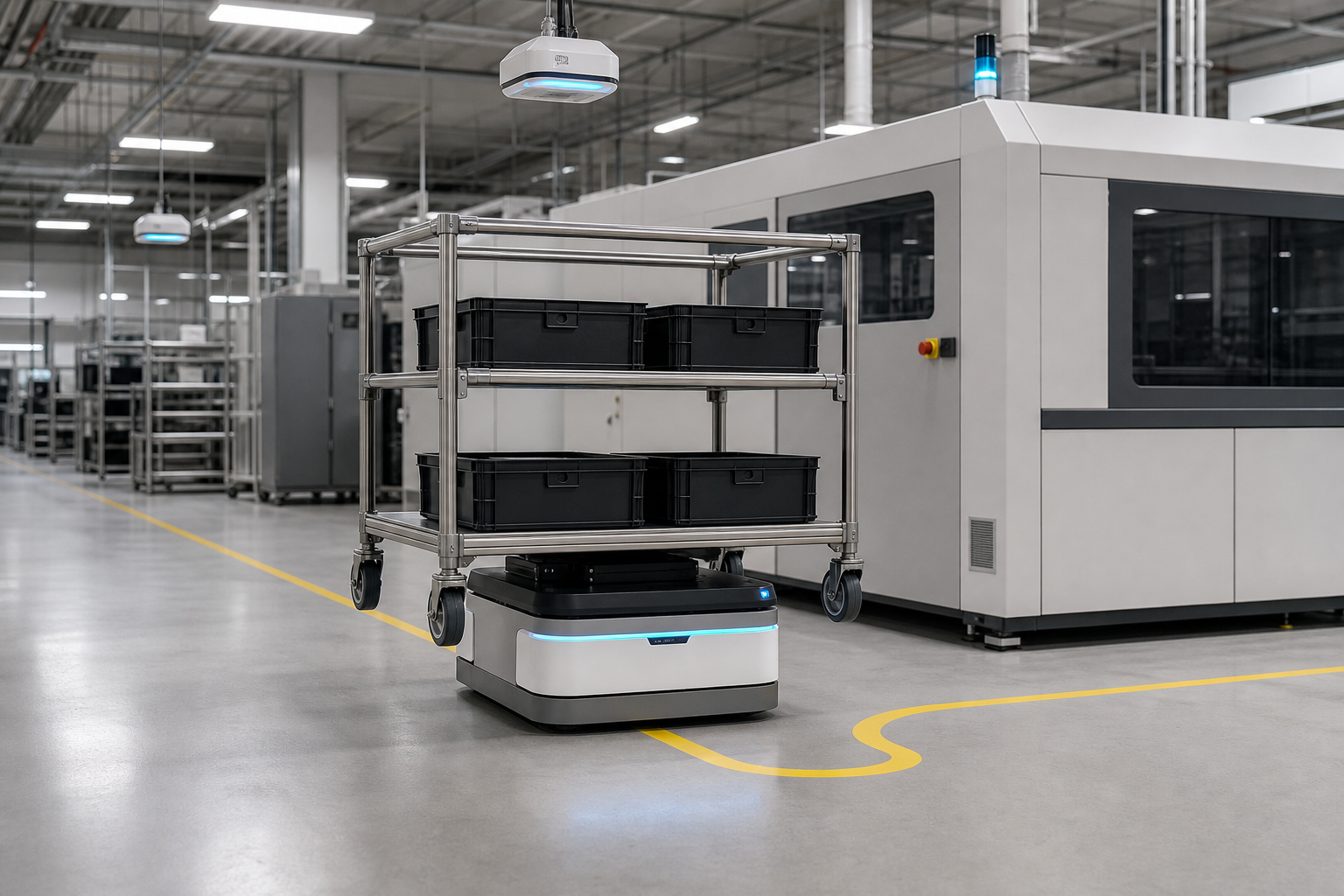
Figure 1: A latent lifting AMR validates wireless behavior along a live route with a loaded mobile rack
Design a roaming window, not simply stronger individual cells
When an AMR moves between adjacent access points, more is happening than a signal-strength change. Scanning, authentication, policy continuity, and application-session behavior all affect the transition. Adding more access points does not automatically make roaming smoother. If overlap, channel planning, client capability, and transition triggers are mismatched, a vehicle can oscillate at a boundary instead of changing connections cleanly.
A stronger engineering approach is to move the roaming window away from critical actions. Avoid arranging a transition exactly where the robot needs a pick or drop confirmation, yields at an intersection, passes through a narrow aisle, or crosses a controlled opening. At the client side, identity, security policy, and reconnect behavior should stay consistent across operating zones. Network and robot teams need to inspect this switching window together; neither group can validate it by testing only its own equipment.
A degraded link should lead to a known next action
Recoverable operation is not a promise that a link will never fail. It is a defined response when it does. A latent lifting AMR carrying a mobile rack should not lower its load arbitrarily in an aisle or at an intersection because of a brief communications event. Under local safety rules, the vehicle can preserve the necessary obstacle protection and speed limits, then select an action that matches the task stage: continue briefly, slow into a designated waiting bay, or pause at a controlled location.
State reconstruction matters just as much. Task progress, carrier state, the last confirmed station, and the reason for the exception should be reconciled unambiguously after connectivity returns. Otherwise, the system can dispatch the same material twice or interpret a completed action as unfinished. A waiting bay must also provide real clearance for the carrier envelope and any turn-out movement. A painted rectangle is not, by itself, a recovery strategy.

Figure 2: When communications degrade, the AMR waits in a designated bay rather than at an intersection
Treat communications as an input to route-change control
Wireless quality is not a parameter fixed by one initial survey. Equipment moves, rack changes, production partitions, antenna relocation, and new lines can alter the communications behavior of a previously validated route. Route version updates, layout changes, and network modifications therefore need a common re-test trigger: identify affected segments, run the relevant vehicle and carrier combinations again, and link exceptions to the current route version.
Daily observations should focus on interpretable operating signals, such as the segments where reconnects cluster, the task states where acknowledgements slow down, and whether waiting repeatedly lands in the same area. Those signals are closer to the actual flow experience than a signal-strength number alone. They also help an operations team invest in the locations that influence throughput rather than chasing isolated readings.
The value of wireless design for an AMR is not a full signal icon. It is predictable task progress in a changing factory. When coverage, roaming, application state, and offline behavior are viewed through the same route lens, a team can move beyond reactive questions about weak signal and design how operations remain controlled when connectivity changes.


邮箱
邮箱验证*
*


